
Physics Research Project Ideas for High School Students


Key Takeaways
- Physics research projects help students investigate scientific questions through experiments, computer simulations, engineering design, and theoretical analysis.
- Strong physics research project ideas focus on measurable variables, clear research questions, and realistic methods for collecting or analyzing data.
- Students can explore research opportunities across mechanics, thermodynamics, electromagnetism, optics, quantum mechanics, astrophysics, biophysics, and nanotechnology.
- Many projects can be completed using affordable tools such as Arduino boards, Raspberry Pi devices, Python programming, and publicly available scientific datasets.
- Physics research can strengthen science fair submissions, college applications, research portfolios, and competition entries.
Physics Research Project Ideas Overview
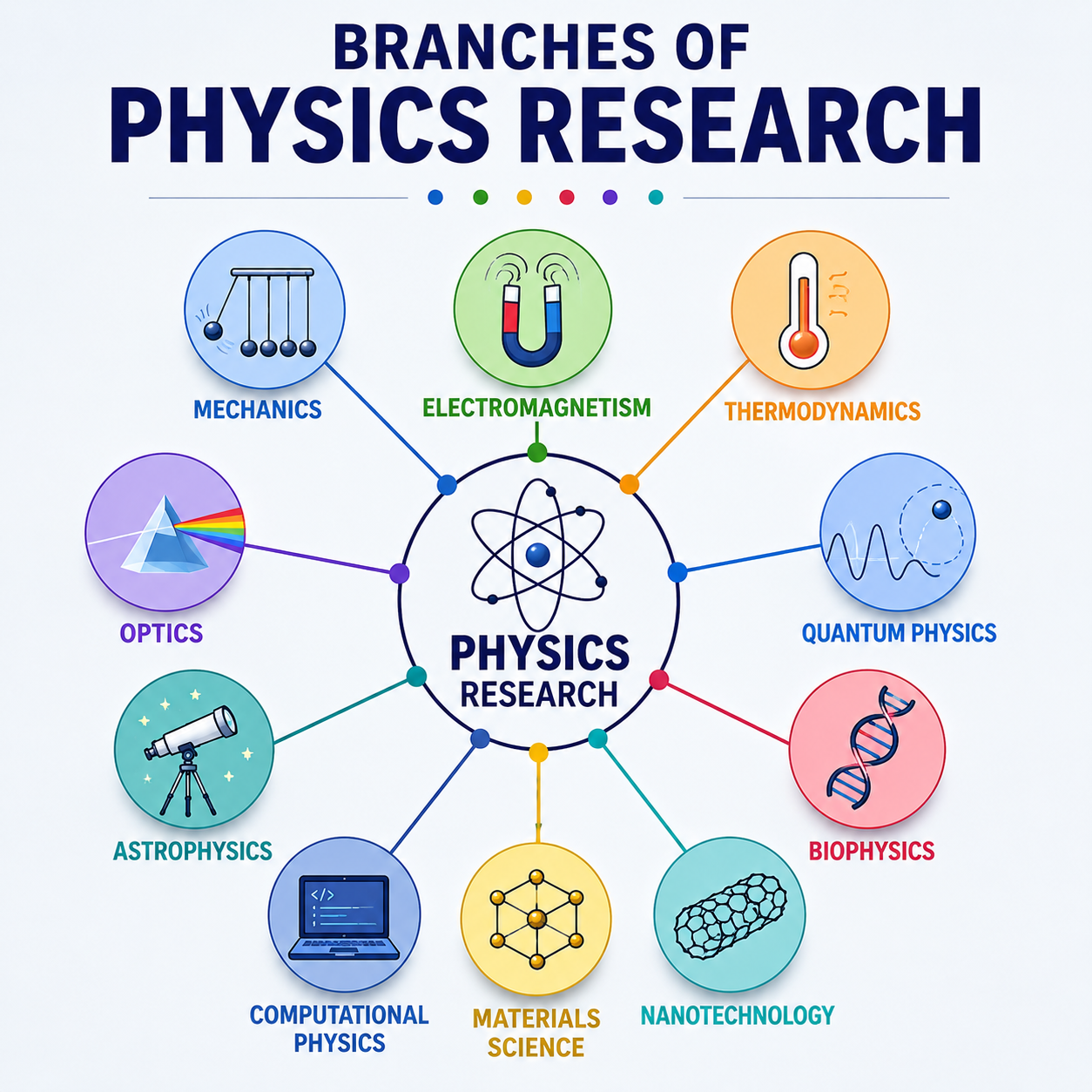
Why Physics Research Projects Matter for High School Students
Physics is an incredibly broad field of study, with subjects ranging from the motion of ordinary objects to the fundamental structure of the universe. Physics research project ideas can be approached through hands-on experiments, computer modeling, engineering projects, and theoretical investigation.
The most successful physics research projects combine curiosity with experimentation, data acquisition, application, and the development of skills for college and further work in a STEM field. Students interested in additional physics research resources can also explore materials from the American Association of Physics Teachers (AAPT), which provides educational programs, student resources, and support for aspiring physicists.
Physics research offers high school students an opportunity to go beyond textbook equations to explore real questions about how the universe works. Instead of simply finding the correct answer, research involves investigating problems that may not have a clear solution. Whether through designing experiments, studying data from telescopes, or creating computer simulations, the process demonstrates how scientists test ideas and make discoveries. Along the way, research helps high schoolers develop valuable skills in critical thinking, problem-solving, and data analysis that can provide a strong foundation for future coursework and careers.
Many of today's most important technologies trace their origins to physics research. The discoveries of Isaac Newton, Albert Einstein, Richard Feynman, Niels Bohr, and Erwin Schrödinger continue to influence fields ranging from aerospace engineering to quantum computing. Physics research has contributed to GPS systems, medical imaging devices, renewable energy technologies, and modern telecommunications.
Skills Students Build Through Physics Research
In addition to scientific knowledge, physics projects help students develop transferable skills that universities and employers value highly.
8 Key Skills Developed Through Physics Research:
- Scientific method
- Experimental design
- Mathematical modeling
- Data visualization
- Scientific writing
- Error analysis
- Computational thinking
- Critical reasoning
What Makes a Strong Physics Research Project for High School Students
Not all physics topics are equally suitable for student research. The strongest physics research project ideas focus on a specific, well-defined question that can be investigated through observation, experimentation, simulation, or mathematical modeling. Strong projects balance intellectual challenge with realistic feasibility, allowing students to collect meaningful data within available time and resources.
Characteristics of Successful Research Topics
Strong physics research topics are:
- Specific and clearly defined
- Testable through measurable evidence
- Quantifiable using data or simulations
- Safe and appropriate for student research
- Grounded in established scientific principles
- Engaging and personally interesting to the researcher
Experimental, Computational, and Theoretical Research Compared
Physics research can take several forms, each offering different advantages depending on available resources and interests.
How to Choose Physics Topics for Research That Actually Fit Your Level
One of the most common mistakes in topic selection is choosing projects that are either too ambitious or too simple. The best physics research project ideas align with a student's current knowledge, available equipment, and timeline. Starting with a manageable project often leads to stronger outcomes than attempting an overly complex investigation.
Beginner Physics Research
Students who are new to research should focus on projects that involve straightforward experimental procedures and easily measurable variables.
Possible beginner concepts:
- Pendulum motion: How does string length affect the period of a pendulum?
- Thermal conductivity comparisons: Which household material insulates heat most effectively?
- Reflection and refraction: How does the angle of incidence affect the angle of refraction in water?
- Diffusion rate versus temperature: How does temperature change the diffusion speed of food dye in water?
- Sound waves: How does frequency affect perceived loudness and wavelength in air?
Intermediate Physics Research
Intermediate students may be ready to explore projects involving electronics, sensors, and more advanced analysis techniques.
Potential intermediate concepts:
- Electromagnetic induction: How does changing magnet speed affect induced current in a coil?
- Solar cell efficiency: How does light angle impact solar panel energy output?
- Signal amplification: How does resistance affect signal gain in a simple amplifier circuit?
- Spectroscopy: How do different light sources produce distinct emission spectra?
- Fluid dynamics: How does pipe diameter affect fluid velocity and pressure loss?
Advanced Physics Research
Advanced students interested in publication, competitions, or mentorship opportunities may explore cutting-edge fields of modern physics.
Advanced physics research concepts:
- Quantum computing: How does noise affect qubit fidelity in quantum simulations?
- Computational astrophysics: How do gravitational interactions affect galaxy cluster formation?
- Nanotechnology: How does nanoscale surface roughness affect electron transport?
- Cosmological modeling: How do dark energy parameters influence universe expansion models?
- Machine-learning applications in physics: Can ML predict chaotic system behavior better than classical equations?
5 Questions to Ask Before Selecting a Topic
Before beginning a project, students should consider:
- What resources are available?
- How much time can be devoted to research?
- Can sufficient data be collected?
- Does the topic align with personal interests?
- Is the project realistic for a high school researcher?
Classical Mechanics and Thermodynamics Project Ideas
Classical mechanics and thermodynamics provide some of the most accessible and rewarding physics research opportunities for high school students. These fields focus on motion, forces, energy, and heat transfer, making it relatively easy to collect quantitative data and perform meaningful analysis.
Classical mechanics topics:
- Rigid body dynamics investigations
- Projectile motion optimization
- Conservation of momentum experiments
- Hooke's law and spring systems
Thermodynamics project ideas:
- Seebeck effect experiments
- Thermal insulation comparisons
- Heat transfer efficiency studies
- Phase change energy investigations
Electromagnetism, Optics, and Photonics Research Topics
Electromagnetism and optics are responsible for many technologies used in everyday life, including wireless communication, imaging systems, fiber optics, and renewable energy devices. These fields provide excellent opportunities for projects that combine theory with practical experimentation.
Electromagnetism experiments:
- Faraday's law experiments
- Magnetic field mapping
- Wireless power transfer studies
- Electromagnetic shielding effectiveness
Optics investigation ideas:
- Laser diffraction analysis
- Lens performance comparisons
- Reflection and refraction studies
- Spectrometer-based investigations
Photonics and Optoelectronics research concepts:
- Optoelectronic waveguide design
- Signal amplification systems
- LED efficiency testing
- Optical sensor development
Quantum Mechanics and Quantum Computing Project Ideas
Quantum mechanics introduces students to some of the most interesting concepts in physics, and while direct experimentation is often limited, many ideas can be explored through simulations, mathematical models, and literature-based research. Students can also extend their work into areas like computational complexity in quantum algorithms, examining how quantum computing differs from classical computing and why qubits may offer advantages over traditional bits for certain types of problems.
Quantum concept project topics:
- Wave-particle duality
- Superposition
- Quantum entanglement
- Quantum tunneling
Quantum computing research opportunities:
- Qubit versus bit information storage
- Bloch sphere visualization
- Quantum algorithm comparisons
- Quantum error correction methods
Astrophysics, Cosmology, and Space Science Research Topics
Astrophysics and cosmology let students explore some of the largest structures in the universe, and thanks to publicly available datasets from NASA and other organizations, many projects can be completed without a laboratory. A major advantage of modern physics research is that students can analyze the same professional scientific data used by working researchers, without needing expensive equipment.
Astrophysics areas of investigation:
- Exoplanet detection methods
- Variable star observations
- Skyglow effects on star visibility
- Stellar tidal disruption event estimation
Theoretical cosmology research projects:
- Dark matter
- Dark energy
- Cosmological inflation
- Galaxy evolution
Biophysics and Biomechanics Research Topics for High Schoolers
Biophysics applies physical principles to biological systems and is one of the fastest-growing interdisciplinary fields, making it especially appealing to students interested in medicine, biomedical engineering, or neuroscience. Research topics such as EEG-controlled bionic prostheses, wearable exoskeleton systems, and motion-tracking technologies show how physics is applied to assistive devices and human–machine interaction.
Biophysics research investigation topics:
- Protein denaturation studies
- Molecular diffusion analysis
- Michaelis-Menten enzyme kinetics modeling
- DNA stability under mechanical stress
Biomechanics inquiry opportunities:
- Walking gait energy expenditure analysis
- Sports motion studies
- Prosthetic limb mechanics
- Human balance investigations
Emerging Technologies in Biophysics to explore:
- EEG-controlled bionic prostheses
- Wearable sensors
- Motion tracking systems
Computational Physics and Simulation-Based Project Ideas
Computational physics is increasingly important because many modern scientific problems cannot be solved through experiments alone, so students can use programming, simulations, and numerical analysis to study complex systems. Computational models are especially useful for investigating phenomena that are difficult to reproduce experimentally, such as shockwave oscillations on transonic aircraft wings and how airflow changes at high speeds.
Simulation project concepts:
- N-body problem simulations
- Planetary orbit modeling
- Fluid dynamics simulations
- Population dynamics models
Research Skills Developed Through Simulation Projects
4 skills students often develop:
- Programming ability
- Numerical simulation skills
- Data visualization expertise
- Computational modeling experience
Nanotechnology, Materials Science, and Optoelectronics Research Topics
Nanotechnology investigates matter at extremely small scales and has applications in medicine, electronics, and energy systems. Materials science focuses on how structure affects the properties of matter, while optoelectronics explores how light and electronic systems interact. Many projects in these fields can be completed through simulations, modeling, or analysis of published experimental data, making them accessible even without advanced laboratory equipment.
Nanotechnology project ideas:
- Nanoparticle position tracking
- Surface coating analysis
- Nano-adhesion systems
- Quantum dot behavior and optical properties
Materials science areas of investigation:
- Shape-memory alloys
- Smart materials
- Composite materials
- Energy storage materials
Optoelectronics studies:
- Optoelectronic waveguide design
- LED efficiency testing
- Photodetector response analysis
- Optical signal amplification systems
Tools and Technologies Used in High School Physics Research
The equipment required for a physics project depends on the field of study. While many projects can be completed with household materials or free software, more advanced investigations may involve sensors, electronics, and specialized measurement devices. Modern student research often combines traditional laboratory equipment with computational tools. Fortunately, many technologies used in physics research have become increasingly affordable and accessible.
Core Physics Laws and Models Every Student Researcher Should Know
Strong physics research project ideas are built on a foundation of key physical laws and models that explain how systems behave. Students working across mechanics, thermodynamics, and materials science frequently apply these principles to design experiments, interpret data, and validate results against established theory.
Students working in these areas frequently encounter the following foundational physics principles:
Software Used by Student Researchers
Modern physics research increasingly relies on computational tools for simulation, data analysis, modeling, and visualization. Learning to use research software can be just as valuable as developing laboratory skills, as many scientific investigations now combine experimental methods with computational analysis.
How to Find Mentors, Labs, and Research Opportunities
Mentors can help students refine research questions, improve methodology, and gain access to resources that might otherwise be unavailable. Even a brief mentorship experience can dramatically improve the quality of a project.
Ways to find research opportunities:
- School science departments
- University outreach programs
- Summer research programs
- Cold emailing professors
- Online mentorship organizations
Physics Competitions and Programs Worth Entering
Many students use physics projects as the foundation for competition submissions. Competitions provide valuable feedback, recognition, and opportunities to connect with other researchers.
Physics Competition Timelines
Physics competitions often require months of preparation, experimentation, and revision. Begin planning early to have more time to collect data, refine methods, and strengthen final presentations before submission deadlines. Understanding common application windows can help with long-term planning.
Organizations and Institutions That Support Student Physics Research
Many organizations offer educational resources, datasets, competitions, and mentorship opportunities that can strengthen student research projects. Students seeking advanced opportunities may also explore programs offered by the Davidson Institute, which supports gifted young researchers, and the Yale Leitner Family Observatory in New Haven, Connecticut, which provides educational astronomy experiences and observational opportunities for students interested in astrophysics.
Major physics research organizations:
- NASA
- CERN
- DESY
- Society for Science & the Public
- American Association of Physics Teachers
- Astronomical League
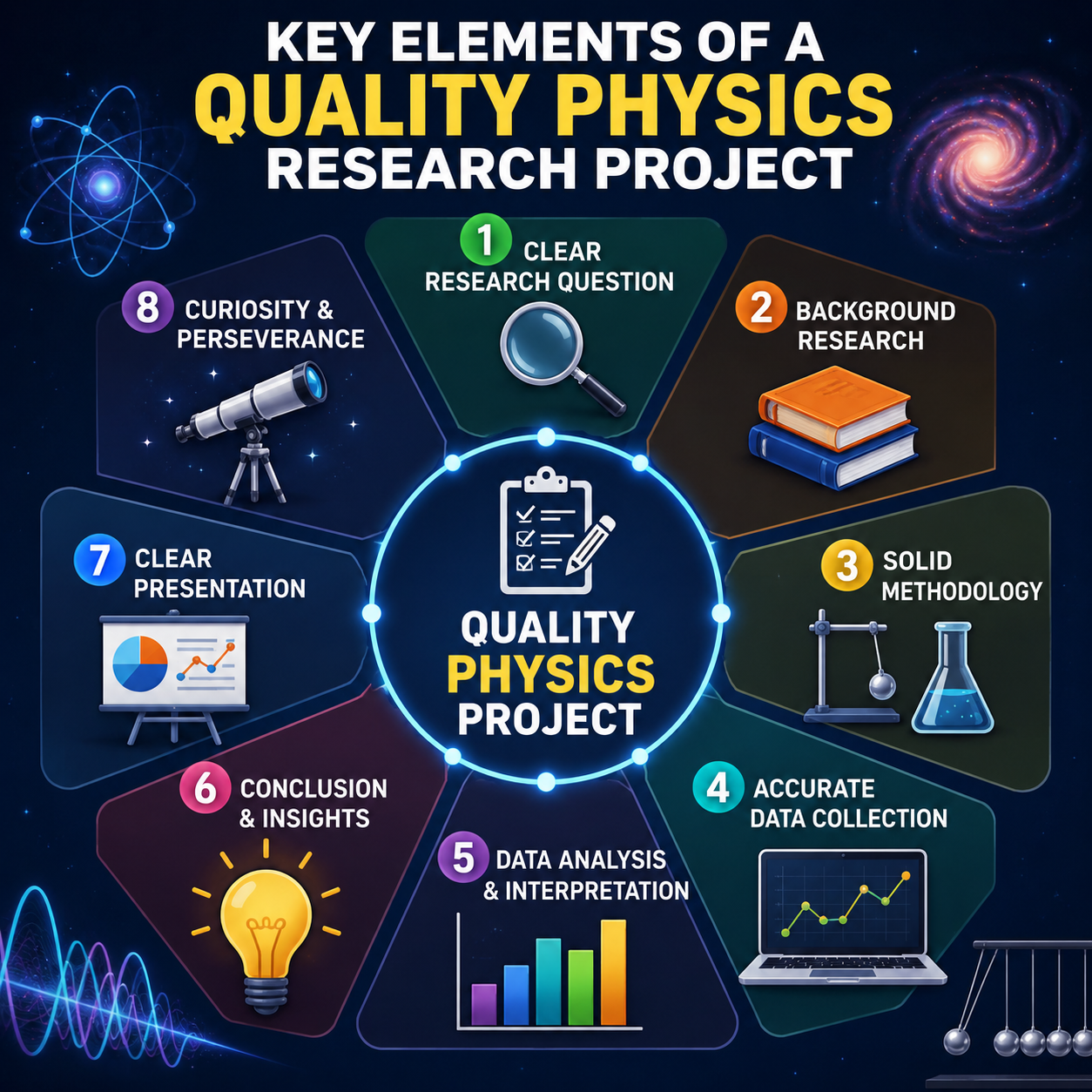
How to Structure and Present Your Physics Research Project
Completing a project is only part of the research process. Students must also communicate their findings clearly and effectively. Strong presentations often distinguish highly successful projects from average ones.
6 components of a strong research project:
- Research question
- Hypothesis
- Methodology
- Data collection
- Analysis
- Conclusion
How Physics Research Projects Help With College Applications
Physics research demonstrates intellectual curiosity, initiative, and a willingness to pursue learning beyond the classroom. These qualities are highly valued by university admissions officers, particularly for STEM-focused programs.
What admissions officers value:
- Independent thinking
- Long-term commitment
- Research communication skills
- Quantitative reasoning
- Real-world problem solving
Portfolio pieces that stand out:
- Research papers
- Competition entries
- Scientific posters
- Computational models
- Engineering prototypes
Helpful Resources
- American Association of Physics Teachers (AAPT) & ComPADRE Digital Library: Physics education resources, competitions, and enrichment opportunities
- NASA Science: Astronomy, astrophysics, cosmology resources, and public scientific datasets
- CERN Education and Outreach: Particle physics resources, educational materials, and open data
- arXiv Physics Archive: Open-access physics research papers and preprints
- Google Scholar: Academic literature searches and scientific publications
- Astronomical League: Astronomy education programs, observing projects, and student opportunities
- PhET Interactive Simulations: Free physics simulations developed by the University of Colorado Boulder
- Society for Science & the Public: Information on the Regeneron International Science and Engineering Fair and other research competitions
- American Physical Society (APS): Physics news, educational resources, and career information
- James Webb Space Telescope Data Archive: Public astronomical datasets for student research projects
For more inspiration and ideas, explore these Indigo Research articles on the PhysicsBowl Contest: Full Guide & How to Win and the Most Prestigious Science Journals to Publish a Research Paper.
Final Thoughts: Choosing the Right Physics Research Project
The best physics research project ideas combine curiosity, scientific rigor, and realistic goals. Whether you are investigating classical mechanics, building computational simulations, analyzing astronomical data, or exploring quantum computing concepts, with careful planning, thoughtful analysis, and strong communication, your work can become a meaningful step toward a future career in STEM, a strong foundation for university-level study, and a path toward becoming a published researcher.
FAQ
What are the best physics research project ideas for beginners?
Beginner-friendly physics research projects include pendulums, projectile motion, thermal conductivity, sound waves, and light reflection or refraction experiments.
Can I do physics research without access to a laboratory?
Yes, many physics research projects use simulations, programming, or public datasets instead of a physical lab.
What are the most interesting topics in physics for high school students?
Interesting topics include quantum mechanics, astrophysics, dark matter, nanotechnology, renewable energy, and biomechanics.
Are computational physics projects accepted at science fairs?
Yes, computational physics projects are widely accepted if methods, data, and analysis are clearly explained.
How long should a physics research project take?
Most projects take between six weeks and several months, depending on complexity and scope.
What programming language is best for physics research?
Python is the most commonly used language for physics research due to its simplicity and scientific libraries.
Do I need a mentor to complete a physics project?
No, but having a mentor can improve research quality and help with design and analysis.
What equipment is required for most high school physics projects?
Most projects require basic tools like timers, rulers, sensors, or a computer for simulations.
Can theoretical physics projects qualify for competitions?
Yes, theoretical and computational physics projects can qualify if they include clear methods and analysis.
Where can high school students find free physics research data?
Free physics data is available from NASA, ESA, CERN, arXiv, and other public scientific databases.
What physics topics look strongest on college applications?
Strong topics include astrophysics, quantum computing, biophysics, computational modeling, and engineering-based research.
What makes a physics research project different from a science fair experiment?
A research project is broader and may include modeling, analysis, or literature review, while experiments focus mainly on testing a single hypothesis.
A strong physics research project does more than demonstrate technical knowledge—it showcases curiosity, problem-solving ability, and the initiative to tackle complex questions independently.
At Indigo Research, students work one-on-one with expert mentors from leading universities to design and complete original research projects. From refining a research question to producing a publication-ready paper, our mentorship programs help ambitious students transform curiosity into meaningful academic achievement. Explore how Indigo Research can help you take your passion for physics to the next level.
.png)
.png)
.png)
.png)