
Chemistry Research Project Ideas for High School Students


Key Takeaways
- Chemistry research projects allow high school students to investigate measurable scientific questions through experimentation, with common research areas including environmental chemistry, biochemistry, food chemistry, electrochemistry, and analytical chemistry.
- Strong chemistry research questions focus on one measurable variable and a specific outcome, for example, “Which electrolyte solution produces the highest battery voltage?” rather than broad topics like “batteries” or “energy.”
- Common data collection methods include pH testing, titration, colorimetry, fermentation experiments, spectroscopy, and water quality analysis, all of which produce measurable results that can be analyzed alongside scientific research sources.
- Chemistry projects that combine experimental data with a final product, such as a science fair poster, research paper, laboratory report, or video presentation, create stronger portfolio pieces than experiment-only submissions.
- Safe chemistry research requires proper laboratory procedures, including Personal Protective Equipment (PPE), Safety Data Sheets (SDS), chemical handling protocols, and adult supervision when working with hazardous materials or heat sources.
Chemistry Research Project Ideas Overview
Why Chemistry Research Projects Matter for High School Students
Chemistry research projects help students move beyond memorization and start thinking like scientists. Instead of simply following classroom lab instructions, students learn how to form hypotheses, test variables, analyze results, and investigate real-world problems. One of the most rewarding aspects of chemistry research is the possibility of discovering something unexpected. Rather than simply following instructions from a textbook, students investigate questions with uncertain outcomes and analyze real experimental results. Even small projects can reveal new patterns, surprising reactions, or fresh ways of understanding everyday chemistry.
Following the work of scientists like Susan Solomon, whose research on atmospheric chemistry helped shape modern climate science, and Nobel laureates such as Paul Modrich and John Clauser, chemistry research continues to play a key role in solving real-world scientific problems.
The strongest chemistry research projects combine scientific curiosity with hands-on experimentation and real-world applications while helping students develop laboratory, research, writing, and analytical skills that are valuable both in college and future STEM careers. Students interested in additional chemistry and health-related research resources can also explore materials from the National Institutes of Health.
Skills Students Build Through Chemistry Research
7 Key skills gained through chemistry research:
- Scientific method
- Experimental design
- Data visualization
- Statistical analysis
- Research writing
- Lab safety procedures
- Independent thinking
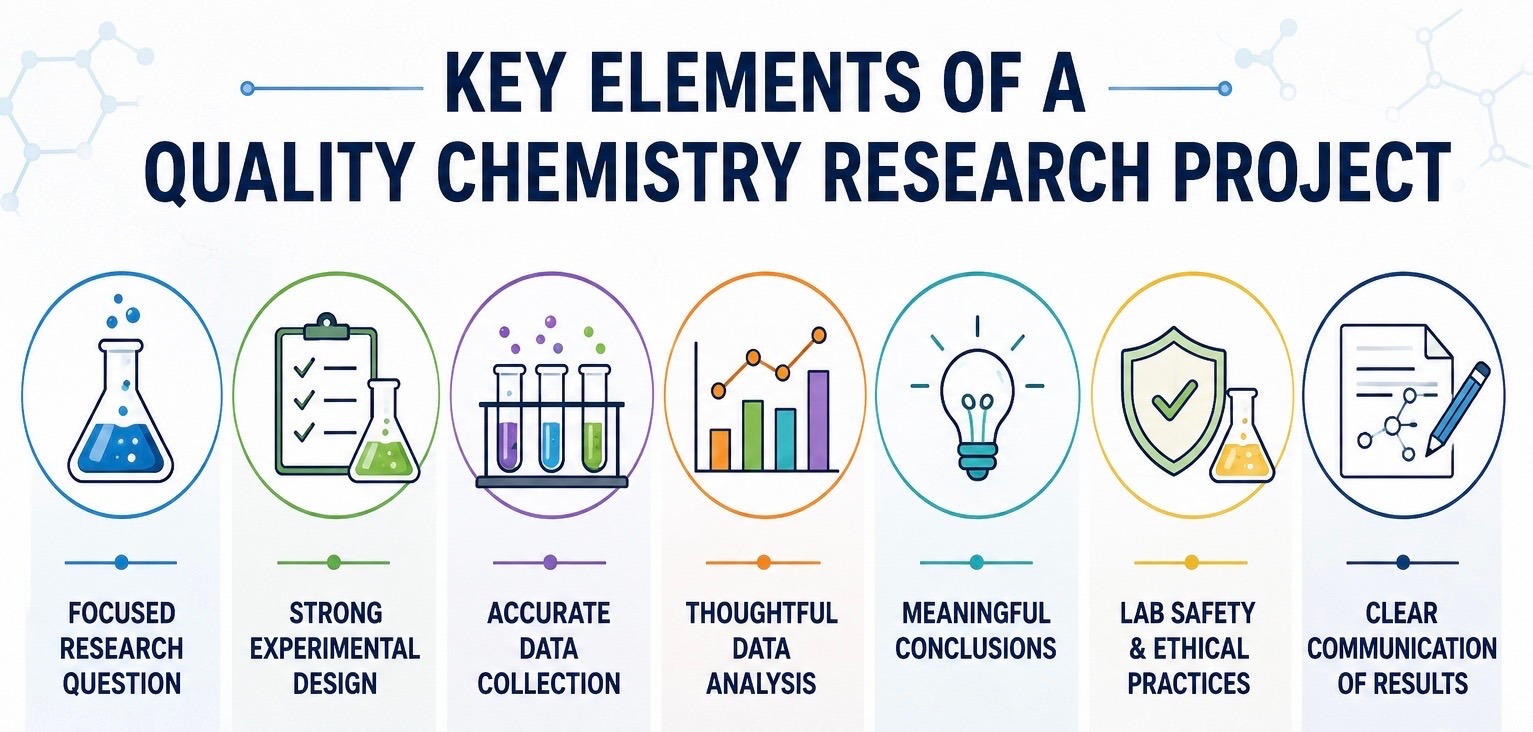
How To Choose a Good Chemistry Research Topic
The best chemistry research project ideas are specific, measurable, and realistic for a student’s available time, equipment, and skill level. Many students make the mistake of choosing overly broad topics that are difficult to test or analyze effectively. A strong chemistry project starts with a focused research question that can produce clear, measurable results.
What Makes a Strong Chemistry Research Question
A quality chemistry research question clearly defines what you want to investigate and sets the direction for your experiment or study. It is specific, clearly defined, and narrow enough to be tested through an experiment, identifying measurable variables.
Good research questions are:
- Testable
- Focused
- Safe
- Affordable
- Relevant to real-world problems
How To Design a Strong Chemistry Experiment
Chemistry experiments start with a clear hypothesis and one specific question you want to test. Students should focus on changing one variable at a time while keeping other conditions constant to ensure reliable, reproducible results. It’s also important to choose a project that is realistic for your available time, materials, and lab setup.
5 key components of experimental design:
- Independent variable: The factor intentionally changed during the experiment
- Dependent variable: The measurable result affected by the independent variable
- Controlled variables: Conditions kept constant throughout the experiment
- Repeated trials: Multiple tests are used to improve accuracy and reliability
- Data collection methods: Ways of recording results, such as pH testing, titration, or spectroscopy
Environmental Chemistry Project Ideas
Environmental chemistry is one of the most popular areas for high school chemistry research because it connects directly to real-world issues like pollution, water safety, and sustainability. These chemistry research project ideas allow students to collect local samples, analyze environmental data, and investigate scientific problems affecting their own communities. Many of these projects also work especially well for science fairs because they combine hands-on experimentation with measurable results.
Environmental chemistry topics:
- Water quality testing
- Heavy metal ions in water
- Soil contamination
- Air pollution particles
- Ocean acidification
- Carbon dioxide concentration
- Volatile organic compounds (VOCs)
Common equipment used:
- pH meter
- Water testing kits
- Spectrophotometer
- Sample collection containers
- Colorimeter
Biochemistry and Biology-Based Chemistry Projects
Biochemistry combines chemistry and biology to study the chemical processes inside living organisms. These chemistry project ideas are especially popular among students interested in medicine, genetics, microbiology, or health sciences. Many of these experiments also introduce students to laboratory techniques commonly used in university and professional research settings.
Popular biochemistry project ideas:
- Enzyme activity experiments
- Fermentation comparisons
- Vitamin C degradation
- UV-induced DNA damage
- Microbial growth analysis
- Kombucha fermentation chemistry
Food Chemistry Project Ideas
Food chemistry projects are some of the most accessible chemistry research project ideas for high school students because many experiments can be completed using affordable household materials. Despite their simplicity, these projects teach important chemistry concepts like acidity, oxidation, solubility, and chemical reactions. Food-based experiments are also excellent for beginners who are new to independent research and experimental design.
Interesting food chemistry topics:
- The Maillard reaction
- Acidity in beverages
- Soap-making chemistry
- Solubility experiments
- Sports drink composition
- Natural food dyes
Household materials often used:
- Vinegar
- Baking soda
- Salt
- Sugar
- Oils
- Food coloring
Energy, Battery, and Electrochemistry Projects
Electrochemistry and energy storage projects are especially relevant today because of growing interest in renewable energy, sustainability, and battery technology. These projects help students explore how chemical reactions produce electricity and how scientists design more efficient energy systems. Many of these experiments also combine chemistry concepts with engineering and physics principles.
Electrochemistry and energy topics:
- Lemon battery experiments
- Electroplating metals
- Biodiesel production
- Algal biofuels
- Energy storage efficiency
- Biodegradable plastics
Analytical Chemistry Project Ideas
Analytical chemistry focuses on identifying, measuring, and comparing chemical substances. These chemistry project ideas are great for students who enjoy precision, data collection, and quantitative analysis. Many analytical chemistry projects also teach students how professional laboratories test materials in medicine, environmental science, and manufacturing.
Analytical chemistry experiments:
- Acid-base titration
- Colorimetry
- Spectroscopy
- Chromatography
- Reaction kinetics
- Electrolysis testing
Important research skills:
- Precision measurements
- Data collection
- Graphing results
- Statistical analysis
- Reproducibility
What Reagents and Lab Equipment You Will Actually Need
Most high school chemistry research projects only require a small set of basic laboratory tools and materials. The exact equipment depends on the type of project, but many experiments can be completed using affordable supplies from a school lab or household materials. Before starting a project, students should always check whether certain chemicals or tools require adult supervision or special safety precautions.
Chemistry Lab Safety for High School Students
Safety is one of the most important aspects of any chemistry research project, especially when students begin working with more hazardous chemicals, heat sources, or biological materials. Following proper lab safety procedures helps prevent injuries and teaches students how professional scientists conduct responsible research. Every chemistry experiment should begin with preparation and a clear understanding of chemical risks.
In structured research environments, chemistry projects may also require review through a Scientific Review Committee (SRC) and completion of a Risk Assessment Form before experiments begin. These steps help evaluate potential hazards, classify chemical risks, and ensure appropriate supervision and safety planning.
Important lab safety rules:
- Wear Personal Protective Equipment (PPE) at all times during experiments
- Read every Safety Data Sheet (SDS) before handling chemicals
- Never mix unknown or untested chemicals
- Use adult supervision when required
- Follow all hazardous chemical handling and disposal guidelines
Biosafety considerations in student research:
- BSL-1: Basic laboratory work using low-risk, non-pathogenic materials commonly used in high school chemistry
- BSL-2: Moderate-risk biological experiments that require additional supervision, training, and controlled lab conditions
Before starting any experiment:
- Review the Safety Data Sheet (SDS) for all reagents and materials
- Identify corrosive, irritant, or reactive substances
- Confirm supervision and lab approval requirements
- Prepare a complete experimental procedure before beginning work
How To Find Mentors, Labs, and Research Opportunities
Mentors, summer programs, school science departments, and university outreach programs can help students strengthen experimental design, improve lab techniques, and gain access to equipment that may not be available at home. Research mentorship can also help students better understand how professional scientists approach investigations and data analysis.
Helpful research organizations and databases include the National Institutes of Health (NIH), EMBL-EBI (European Bioinformatics Institute), and structured academic programs, such as the Extended Project Qualification (EPQ), which support student-led scientific inquiry and the development of supercurricular research.
Ways to find research opportunities:
- Cold emailing professors
- School science departments
- Summer research programs
- University outreach programs
- Online mentorship organizations
How To Present a Chemistry Research Project
A strong chemistry research project is not complete until students can clearly communicate their findings, methods, and conclusions. Presentation is often where students demonstrate the highest level of scientific understanding, because it requires them to translate complex data into clear, structured insights. Whether for a science fair, research paper, or portfolio, the way a project is presented can significantly influence how it is evaluated.
Common final project formats:
- Research paper
- Science fair poster
- Video presentation
- Research abstract
- Blog or website
- Podcast episode
When Students Typically Present Their Chemistry Projects
In the United States, science research projects often follow an academic calendar that aligns with science fairs and school deadlines. Understanding this timeline helps students plan their experiments realistically, leaving enough time for data collection, analysis, and revision before final submission. Every science fair has its own exact timeline, so always check the dates and deadlines carefully.
Why Timing Matters in Chemistry Research
Planning around a timeline is important because chemistry experiments often require repeated trials, controlled conditions, and time for data to stabilize. Students who start early are more likely to produce reliable, reproducible results and avoid rushed conclusions. A structured timeline also helps ensure that the final presentation reflects a complete research process rather than an incomplete experiment.
How Chemistry Research Projects Help With College Applications
Chemistry research projects can strengthen college applications by giving students concrete academic experiences to discuss in essays, interviews, and activity lists. A well-developed project demonstrates initiative, intellectual curiosity, long-term commitment, and the ability to work independently on complex scientific questions. Universities increasingly value students who pursue learning outside the classroom and develop sustained projects connected to their academic interests, especially in competitive STEM, engineering, environmental science, and pre-med pathways. Admissions officers also look for evidence of deeper scientific engagement and communication skills that go beyond classroom learning. Strong chemistry research projects show that a student can design, execute, and explain real investigations with real-world relevance.
Beneficial additions for the college admissions process include:
- Science fair projects
- Research papers
- Summer program applications
- College application portfolio pieces
- Independent research experience
What university admissions officers like to see:
- Long-term commitment
- Independent thinking
- Scientific curiosity
- Research communication skills
- Real-world applications
Helpful Links
- NIH Chemistry and Health Resources
- Science Buddies Chemistry Projects
- PubChem Database
- ChEMBL Database
- EMBL-EBI
For more ideas and inspiration, check out this Indigo Research blog on the most prestigious science journals to publish a research paper.
Final Thoughts: Choosing the Right Chemistry Research Project
The best chemistry research project combines curiosity, creativity, and scientific thinking. Whether students are exploring water quality, battery chemistry, fermentation, or biodegradable plastics, research projects help develop skills that extend far beyond the classroom. A strong chemistry project can become a winning science fair entry, a published research paper, a top mentorship opportunity, and the beginning of a future STEM career!
Take the next step by joining Indigo Research’s mentorship program and turn your project into a fully developed, publishable research paper.
FAQ
What are good chemistry research project ideas for beginners?
Food chemistry, pH testing, and simple electrochemistry experiments are great beginner-friendly options.
Can I do a chemistry research project at home?
Yes, many chemistry project ideas use safe household materials, though advanced experiments may require access to a school laboratory.
How long should a chemistry research project take?
Most projects take anywhere from 6 weeks to several months, depending on complexity.
Do I need a mentor for a chemistry project?
Not always, but mentors can help students improve experimental design, lab safety, and data analysis.
What chemistry field is best for high school students?
Environmental chemistry, food chemistry, and analytical chemistry are often the most accessible starting points.
Whether you're interested in sustainable materials, environmental chemistry, pharmaceuticals, or energy innovation, a strong research project can help you stand out in science fairs, college applications, and future STEM opportunities.
At Indigo Research, students work alongside expert mentors from leading universities and research institutions to transform their ideas into rigorous, publishable research. If you're ready to take your chemistry project beyond the classroom, explore how Indigo Research can help you develop an original study, strengthen your scientific skills, and create work that makes a real impact.
.png)
.png)
.png)
.png)