
The Navy SEAP Internship – Is This Summer Program Worth It? (2026)

.jpeg)
Yes, the SEAP internship is a good choice for high school students who are serious about STEM. It is one of the few paid, federally run research internships in the United States, with an acceptance rate of 3% to 13%. If you land a spot, you spend 8 weeks working in a real Navy lab, earning up to $4,500. It is administered by the Department of Navy (DoN) and American Society Engineering Education (ASEE).
Key Takeaways
- SEAP internship is free to apply and pays you. As a first-time student, you will get a $4,000 stipend. Students who come back for a second summer earn $4,500.
- The program lasts 8 weeks. You work 40 hours a week inside one of 35+ Department of the Navy (DoN) labs in the U.S. and gain hands-on STEM research experience.
- Getting in is hard. Acceptance rates run between 3% and 13% with ~300 placements available.
- You must be a U.S. citizen and at least 16 years old. Sophomores, juniors, and seniors can all apply. Graduating seniors are also welcomed.
- SEAP is a launch pad. Doing well here opens the door to the Naval Research Enterprise Internship Program (NREIP) in college, and from there to full-time DoN/DoD careers.
What Is the Navy SEAP Internship?
The Science and Engineering Apprenticeship Program (SEAP) is an 8-week summer internship for high school students. It is run by the Department of the Navy (DoN). The Navy STEM internship gives students a chance to work on real science and engineering research.
SEAP started in the 1980s. Its goal is to help talented students learn about science, technology, and research careers connected to the Navy and the Department of Defense, making it one of the top naval STEM internships available.
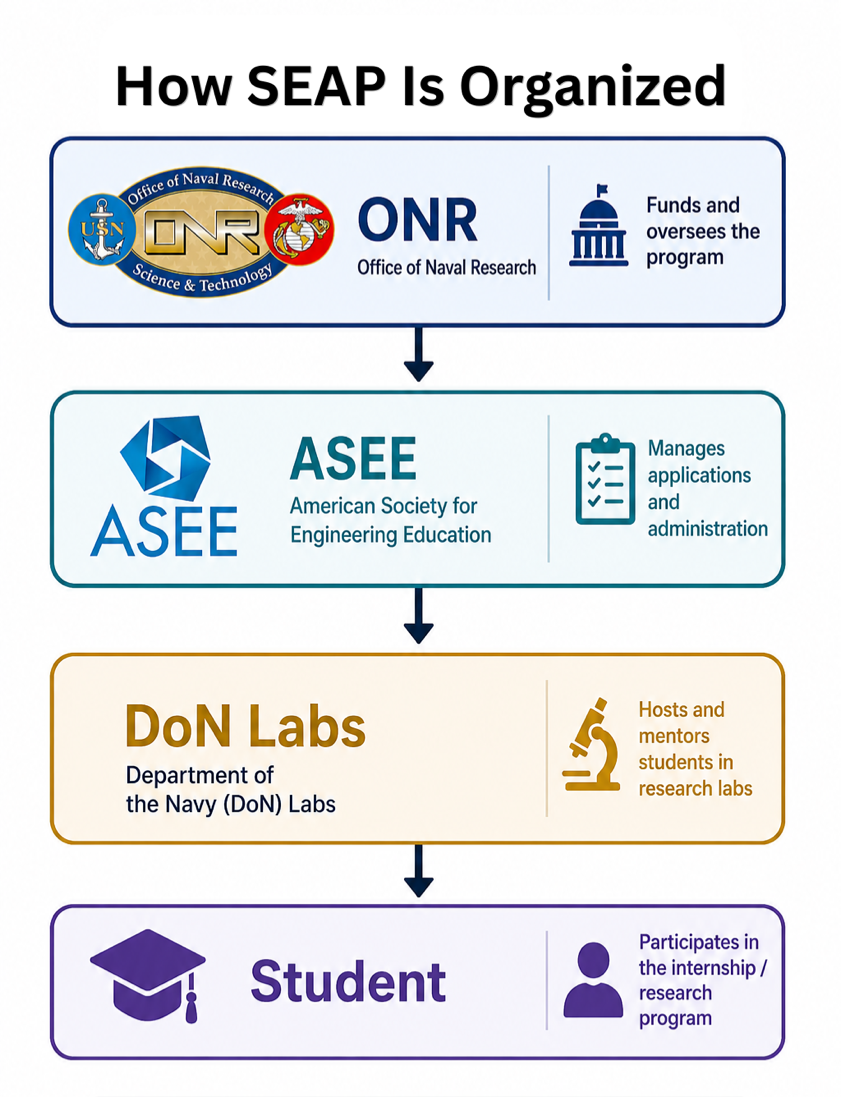
Two groups help run SEAP. The Office of Naval Research (ONR) pays for the program and sets its goals. The American Society for Engineering Education (ASEE) manages the application process, student matching, and program updates. When you email a question about your application, you are writing to ASEE. When your tax form shows who paid you, it points back to ONR. Dr. Reginald G. Williams serves as the program officer at ONR.
Once you are matched for the Navy SEAP internship, you go to one of more than 35 Department of the Navy labs around the country. Your day-to-day supervisor is a real Navy scientist or engineer who agrees to be your mentor for the summer.
Who Is Eligible for SEAP?
The rules for who can apply are simple, but two of them trip up applicants every year. Here is the full list:
- U.S. citizenship is required. This is a firm rule because you will be working inside a government building. Students who hold dual citizenship or permanent residency might be allowed at certain labs. This depends on the specific lab, not the program as a whole. Ask the lab if this applies to you.
- You must be at least 16 years old on the first day of the internship. Not when you apply but when the program starts. If your 16th birthday falls after the program begins, you cannot join that year.
- You must have finished at least Grade 9. Eligible grade levels are sophomore, junior, and senior in high school.
- You must be enrolled in high school. You cannot apply after you have graduated.
A note on graduating seniors: Many people think seniors about to graduate cannot apply. That is wrong. Graduating seniors are eligible. Some labs prefer seniors because they have taken more advanced classes. If you are in your senior year, go ahead and apply – as long as the program starts before your graduation.
SEAP Acceptance Rate: How Competitive Is It?
My honest answer is: very competitive, and getting harder each year. The program places about 300 students per year across 35+ labs. The number of labs has grown a little, but the number of students applying has grown much faster, pushing the acceptance rate down over time.
Here is the data we have:
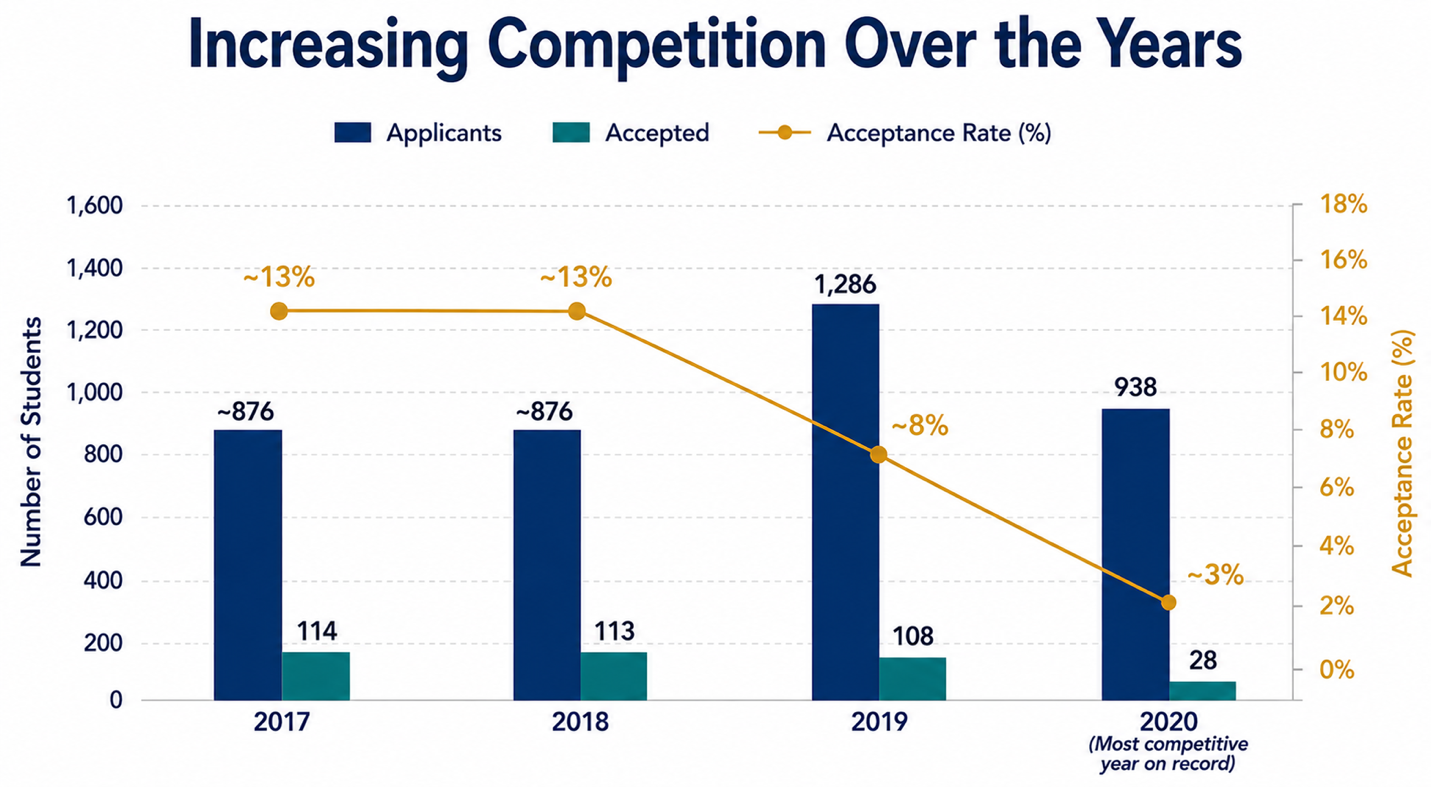
The pattern is clear: as more students become interested in STEM, more are applying to programs like the SEAP internship, and the acceptance rate keeps shrinking. The 938-applicant year produced a 3% acceptance rate, the most competitive on record. The program will not fill all 300 slots if the candidate pool is not strong enough. That means every component of your application matters.
What does the selection team look for? These five things matter most:
- Strong grades in science and math. Your GPA in those subjects matters more than your overall average.
- A great personal statement. This is where most applicants fall short. A general statement about loving science sounds like everyone else's. A statement that names a specific lab, mentions that lab's published research, and connects your own coursework to their work stands out right away.
- Good teacher recommendations. Pick teachers who have seen you do science.
- Standardized test scores. Strong math and science scores give the team a clear benchmark.
- Evidence of STEM interest beyond the classroom. Science fairs, competitions, extra classes, or any sign that you seek out science on your own all help your case.
What You Do During the SEAP Summer Program
The eight weeks feel like a full-time job because they are a full-time job. The SEAP summer program runs 40 hours a week, Monday through Friday, inside a federal laboratory. Most labs cap the total at 320 hours, which is eight weeks at full time.
Each student is paired with a Navy scientist or engineer who serves as their primary mentor. Your day-to-day work depends on which lab you are placed in and what projects are active that summer. The research is real and ongoing because you are contributing to actual DoN research projects, making this one of the most respected naval STEM internships for high school students.
Research Fields Available Through SEAP
- Engineering (mechanical, electrical, aerospace)
- Cybersecurity and information systems
- Oceanography and environmental science
- Materials science
- Computer science and software development
- Physics and chemistry
- Weapons systems and maritime research
Not every lab offers every field. When selecting labs during your application, filter for locations whose published research areas match your interests. For example, the Naval Research Laboratory (NRL) in Washington, D.C. covers materials science, plasma physics, and remote sensing. John C. Stennis Space Center in Mississippi focuses on acoustics and oceanography.
Students interested in a navy internship engineering opportunity often look for labs with strong aerospace, electrical, or mechanical research programs.
The Quad Chart Presentation
At the end of the program, most participants are required to present a quad chart which is a single-page, four-quadrant summary of their research project. This is a standard military research communication tool, and preparing it teaches students to distill technical work into a tight, audience-facing format. It is also a document you can bring to college interviews or include in your application portfolio.
A Realistic Day-in-the-Life

To make this real: imagine you are placed at the Naval Research Laboratory in Washington, D.C., working on a materials science project as part of a naval engineering internship. A typical day might look like this:
- Morning (8 AM – noon): Lab work. You might prepare material samples, run tests on special equipment with your mentor watching, or go over data from the day before.
- Lunch (noon – 1 PM): Often shared with other SEAP students. The friendships you build here can last into your college and career years.
- Afternoon (1 PM – 5 PM): A mix of reading published research related to your project, writing up your notes, sitting in on a lab meeting, or spending one-on-one time with your mentor to review what you found and plan the next steps.
- Week 8: Everything shifts toward your final deliverable. Most labs require a quad chart – a one-page research summary in a standard four-box format that covers your goal, your method, your results, and your conclusions. You present this to the lab's researchers.
In-person is the standard format and the better experience. You are in the lab, using real equipment, meeting real people. Some labs have offered a virtual option in recent years. If you have a choice, pick in-person.
SEAP Stipend, Pay Schedule, and What Is Not Covered
SEAP pays you a set amount called a stipend for finishing the program.
What SEAP Pays
- Stipend: First-time students receive $4,000, while returning students receive $4,500.
- Work hours: Students can work up to 40 hours per week for 8 weeks (maximum 320 hours). This equals about $12.50 per hour for new students and $14.06 per hour for returning students.
- Pay schedule: Students are usually paid bi-weekly through direct deposit, meaning about four payments over the summer.
What SEAP Does Not Cover
Before you accept a placement, know what you are paying for yourself:
- Housing: If your lab is in another city, you need to find and pay for a place to stay for 8 weeks.
- Transportation: Getting to and from the lab every day is on you.
- Medical or health coverage: SEAP does not provide health coverage.
- Security clearance: Some labs work on sensitive research and need a background check before you start.
If you live near a lab, SEAP is a strong deal. But if you need to move for 8 weeks, rent and travel costs can quickly reduce the value of a $4,000 stipend.
How to Apply to SEAP – Step by Step
The timeline starts earlier than most students expect. Here is how it works:
Step 1: Get on the email list (July). The application portal opens on August 1 each year. Sign up for the ASEE mailing list before then so you get the exact date and any updates. The portal is at navalsteminterns.us.
Step 2: Research the labs (July–August). More than 35 Navy labs take part in SEAP. Browse the list at navalsteminterns.us/seap/labs.html before the portal opens. Each lab page shows what topics it studies. Pick two to four labs whose work matches your interests and classwork. This feeds into your personal statement.
Step 3: Gather your documents (August). Collect your school transcript, standardized test scores, and your recommenders' contact information. Ask your recommenders early – well before the portal opens.
Step 4: Write a strong personal statement. Name the specific labs you are targeting. Say what they study. Connect your own coursework and interests to that work. The review team reads hundreds of statements – one that is lab-specific is instantly noticeable.
Step 5: Submit through the portal (August–November). Fill out all fields, upload your materials, and submit through the application portal. Deadlines can shift each year, so watch the mailing list for official dates.
Step 6: Wait for lab contact. After the window closes, individual labs look at candidates for their openings. A lab might reach out to you for more information. Final results come through ASEE.
Step 7: Accept and plan. If you are accepted, confirm right away and start sorting out housing and travel if you are not local to the lab.
How SEAP Helps with College Applications
Describing SEAP internship as a 'college application boost' undersells what it does. It is a research narrative and that is worth understanding before you apply:
It gives you a real story. Nearly every competitive university asks you to explain why you want to study a specific field. A student who spent 8 weeks testing samples at a Navy lab under a working scientist has a much more honest and specific answer than someone who says "I have always loved science."
A mentor recommendation letter is different from a teacher letter. Most high school applicants get letters from classroom teachers. A letter from a federal scientist who supervised your research for 8 weeks tells colleges something very different. It shows what you can do outside the classroom, under pressure, in a real workplace.
Acceptance itself signals ability. Because SEAP's acceptance rate is publicly known to sit at 3–13%, the name on your application tells the reader you are in a very small group, without you having to say anything extra.
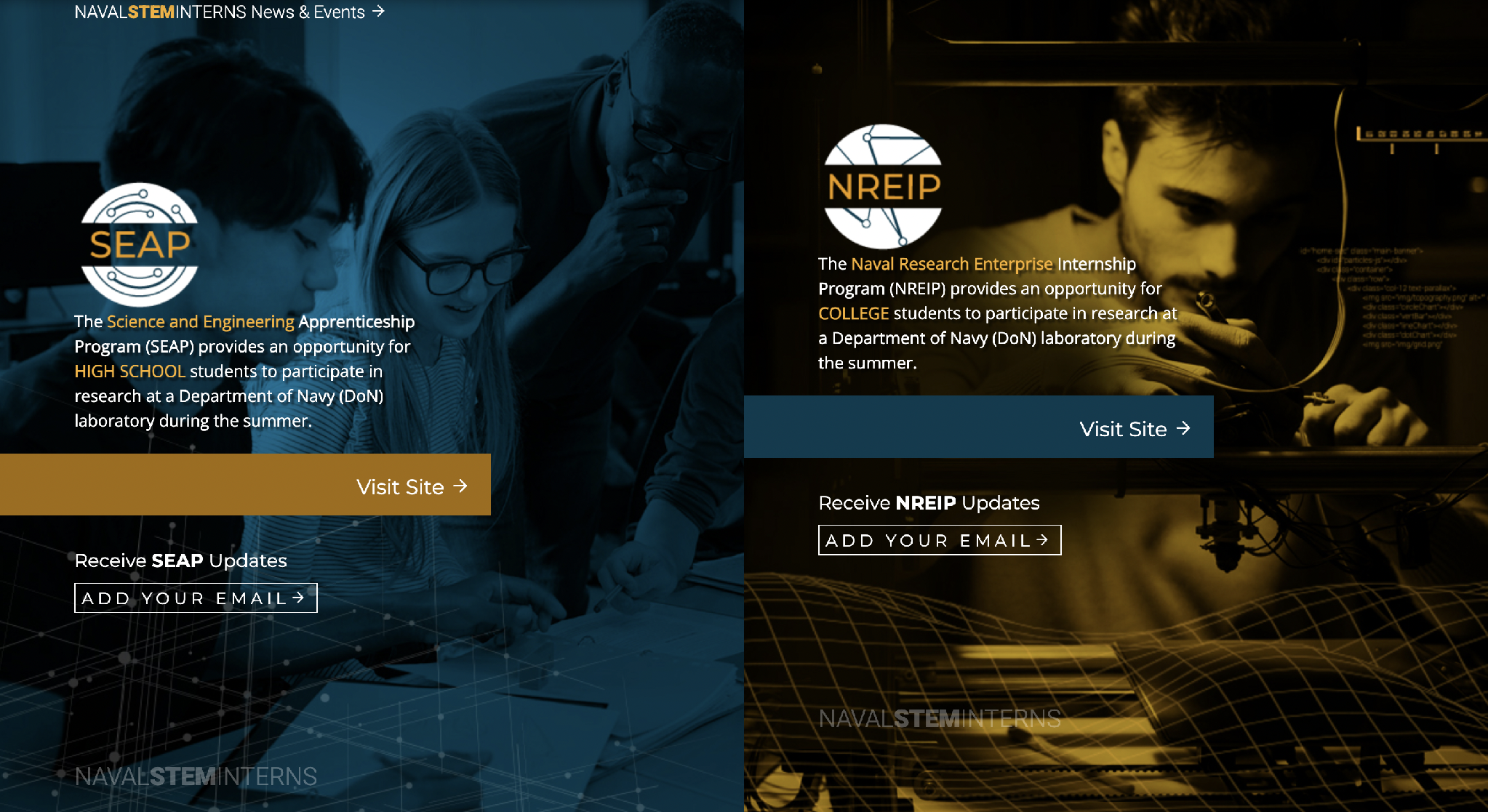
It opens the door to NREIP and a much bigger path. SEAP alumni can apply to the Naval Research Enterprise Internship Program (NREIP) in college. Students who do SEAP in high school, NREIP in college, and then the DoD SMART Scholarship have a realistic path to a funded STEM education and a federal job offer before they graduate. Colleges that know STEM pipelines recognize this track.
SEAP vs. Other High School STEM Internships
SEAP is not the only option. Knowing where it stands helps you decide whether to apply and what to try as a backup.
The SEAP → NREIP → SMART ladder
The most important thing about the SEAP internship is that it is step one of a multi-year path:
Junior Year of High School: Apply to and complete SEAP. Earn $4,000, get 8 weeks of DoN lab research, build a mentor relationship.
Sophomore Year of College: Apply to NREIP using your SEAP experience as your primary research credential. If accepted: 10 weeks, $7,500–$11,500 stipend, same DoN lab ecosystem.
Senior Year of College: Apply to DoD SMART Scholarship. Full tuition coverage, annual stipend, and a guaranteed federal job offer in DoD upon graduation.
Career: Enter DoN or DoD as a fully trained researcher with years of lab experience, a professional network, and no student debt - if SMART is secured.
What if you cannot reach a Navy lab?
The Lumiere Research Scholar Program is the most common private alternative for students who want research experience but live too far from any of the 35+ lab locations. It is not free and does not carry the federal credential, but it can produce real independent research that serves a similar purpose in a college application.
Is SEAP Worth It?
Yes, the SEAP internship is one of the best summer programs available to a high school student in the United States. The combination of real paid work, federal lab access, hands-on mentorship, and a clear path to future opportunities is hard to find anywhere else. For the right student, it is worth building your whole junior-year summer around.
But it is not the right fit for everyone.
SEAP is worth it if you:
- Are serious about going into a STEM field.
- Live close enough to one of the 35+ labs to commute, or can afford to move there for 8 weeks
- Are applying in Grade 10 or 11, giving yourself at least one chance before graduation
- Are ready to put real time into writing a lab-specific personal statement
- Want to build toward the NREIP and SMART path in the years ahead
SEAP may not be the right fit if you:
- Are still unsure about STEM because the SEAP summer program is a full-time commitment of 40 hours a week for 8 weeks
- Live far from all 35+ lab locations and cannot cover 2 months of living costs on a $4,000 stipend
- Are applying in the second half of your senior year. Results come too late to help your college applications at that point
- Are expecting a light, shadowing-style experience. The Navy SEAP internship involves real research, and labs expect real output
My Opinion: With an acceptance rate of 3–13%, most applicants will not get in. Applying to naval STEM internships like SEAP is still worthwhile, but it is smart to have backup plans. Getting rejected does not mean you are not talented – it means you were in an extremely competitive pool.
Frequently Asked Questions
What is the SEAP acceptance rate?
The acceptance rate is 3% to 13%, depending on the year. The program places about 300 students per year. In 2020, the most competitive year on record, 28 students were accepted from 938 who applied – about 3%.
Is the Navy SEAP internship paid?
Yes. Students joining for the first time receive $4,000 for the 8-week program. Students who return for a second year earn $4,500. Pay arrives every two weeks through direct deposit.
Can graduating seniors apply to SEAP?
Yes. Graduating seniors are eligible as long as the program starts before graduation day. Some labs actually prefer seniors because of their more advanced coursework.
Does SEAP require a security clearance?
It depends on the lab. Some Navy labs work on sensitive research and require a background check before you can start. Each lab's profile tells you whether this applies. The government runs the clearance process at no cost to you, but it does add time, so plan ahead if your top-choice lab has this requirement.
Does SEAP provide housing?
No. SEAP does not cover housing or moving costs. If your lab is in a different city, you need to find and pay for your own place to stay for the full 8 weeks. This is the biggest practical thing to work out for students who do not live near a participating lab.
When does the SEAP application open?
The application portal opens on August 1 each year at navalsteminterns.embark.com. Sign up for the ASEE mailing list before August to get the exact opening date and deadline updates.
What happens after SEAP? Is there a college equivalent?
Yes. The Naval Research Enterprise Internship Program (NREIP) is the college version of SEAP. It runs 10 weeks and pays between $7,500 and $11,500. SEAP alumni are in a great position to apply because they already know how Navy labs work and often still have contact with their mentor. Beyond NREIP, the DoD SMART Scholarship can fund your full STEM degree in exchange for a federal job after graduation.